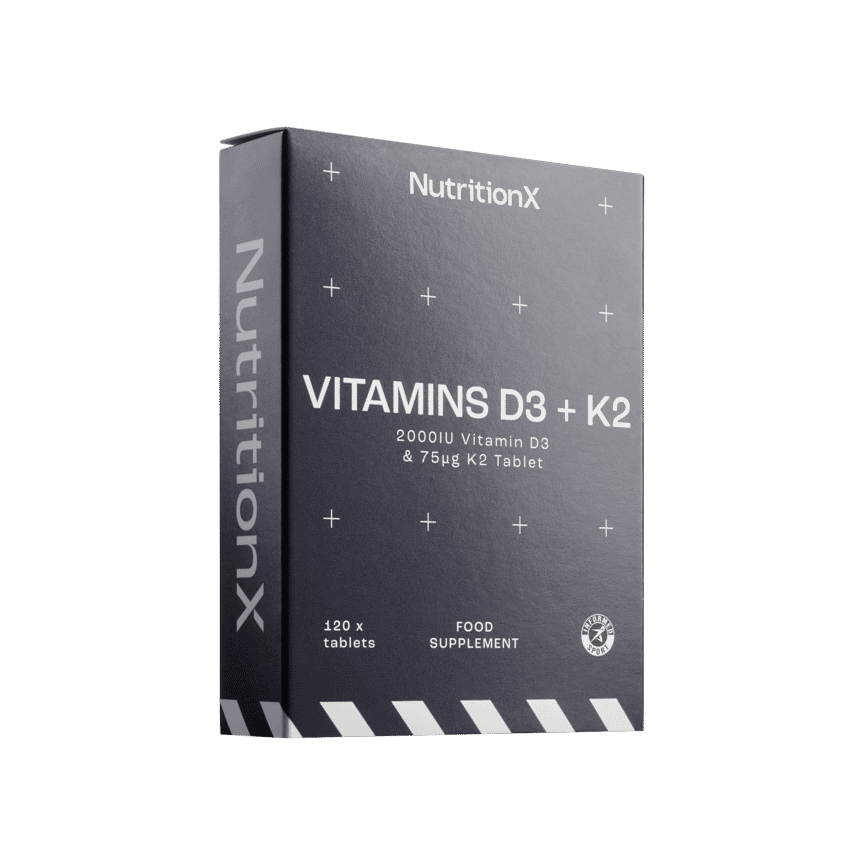


Vitamin D has a reputation as a "safe to megadose" vitamin, on the logic that if a little is good, a lot must be better. However, the research doesn't support this theory. This article covers what the evidence actually shows on safe upper limits, what a sensible day-to-day protocol looks like and how to find out whether you're deficient in the first place.
Yes, you can take too much vitamin D
EFSA and the US Institute of Medicine both set the safe upper limit for vitamin D at 4,000IU per day. Our own lab work suggests this is already well beyond what's needed, since a much lower daily dose is enough to correct a deficiency in most people.
We've tested what happens at the high end directly (Owens et al., 2017). In one study, a professional squad of team sport athletes was given a bolus dose of 70,000IU per week, equivalent to 10,000IU per day. The result was a significant increase in vitamin D catabolism (the rate at which the body inactivates vitamin D) and a drop in parathyroid hormone production. Notably, once supplementation stopped, these inactive breakdown products remained elevated whilst active vitamin D fell; a pattern that could be harmful and may help explain why other research has reported negative effects from very high doses (Sanders et al., 2010).
Separately, a three-year trial in over 300 healthy adults found that 10,000IU per day reduced bone mineral density compared with 400IU per day, the opposite of what you'd want from a bone-health nutrient (Burt et al., 2019).
None of this means moderate supplementation is risky. It simply means megadosing has no evidence behind it and some evidence against it. A daily dose in the 1,000-2,000IU range remains the sensible choice and is the estimated requirement to achieve and maintain optimal vitamin D levels (Cashman et al., 2008).
What's the right vitamin D protocol?
The goal of supplementation isn't to maximise your vitamin D level, it's to maintain an adequate one. The research suggests the main performance and health benefits of vitamin D come from sitting in a healthy range, not from pushing levels as high as possible.
A simple seasonal protocol, based on the research:
| Season | What to do | Dose |
| Autumn/winter | Supplement daily, since UVB exposure is too low to make your own | 1,000-2,000IU vitamin D3 per day |
| Spring/summer | Sensible sun exposure is
usually enough on its own |
~15 minutes on arms and legs, without burning |
Choose vitamin D3 (cholecalciferol) over vitamin D2 (ergocalciferol) if you're supplementing. Research shows D3 is the more effective of the two forms at raising and maintaining blood vitamin D levels.
How do you know if you're deficient?
Vitamin D status is measured through a blood test for 25-hydroxyvitamin D (25[OH]D), the standard marker used to assess vitamin D levels. This can be collected via a standard blood draw or, increasingly, a simple finger-prick blood spot test, which is more convenient logistically and has been validated as accurate. Where possible, high-performance liquid chromatography with tandem mass spectrometry (HPLC-MS/MS) is considered the most accurate and reliable lab method (Snellman et al., 2010).
Results can be reported in two different units depending on the lab: nmol/L or ng/mL (1 ng/mL = 2.496 nmol/L). Once you have a number, here's how it's generally classified:
| Blood 25(OH)D level | Status |
| Below 12 nmol/L | Severely deficient |
| 12–30 nmol/L | Deficient |
| 30–50 nmol/L | Inadequate |
| Above 50 nmol/L | Adequate |
| Above 75 nmol/L | Possibly optimal for athletes |
| Above 180 nmol/L | Potentially too high |
Given the growing support for 75 nmol/L as the cut-off for optimal vitamin D status, a simpler approach is to aim for >75 nmol/L whilst staying below 180 nmol/L.
One important caveat: interpreting these numbers isn't always straightforward. Emerging research suggests that ancestry may affect how a given 25(OH)D reading should be interpreted. People of Black African and African-Caribbean ancestry typically show lower 25(OH)D but higher active 1,25(OH)2D, superior bone mineral density and better calcium retention and absorption compared with people of White European ancestry (e.g. Weaver et al., 2008). In practice this means that a reductionist approach of using only 25(OH)D to determine vitamin D status might be outdated, and we should also consider the athlete's ancestry and clinical and biochemical signs of deficiency, such as low bone mineral density, elevated PTH and tiredness/weakness when interpreting a low 25(OH)D value.
Who's most at risk, and what happens if you stay deficient?
Being fit and active doesn't protect you from low vitamin D. Athletes have repeatedly been shown to become deficient over the winter months (Close et al., 2013b; Morton et al., 2012), in line with the general population, because the UK simply doesn't get enough UVB radiation to sustain natural production from October to March.
Left uncorrected, low vitamin D status has been linked to:
- Reduced calcium absorption and bone mineralisation (Berry, Davies and Mee, 2002), relevant for anyone concerned about stress fracture risk.
- Impaired muscle function, though this mainly shows up at very low concentrations, below roughly 25nmol/L, rather than at mild deficiency (Stockton et al., 2010).
- Impaired recovery from muscle-damaging exercise (Owens et al., 2015)
- Impaired muscle metabolism (Sinha et al., 2013).
- Increased susceptibility to infection, which matters because, after injury, illness is the biggest cause of lost training and competition time for athletes (Walsh, 2019).
Quick reference summary
- Inadequate or deficient (below 50nmol/L) Supplement with 1,000-2,000IU of vitamin D3 daily through autumn and winter.
- Don't exceed 4,000IU per day without good reason. There's no evidence higher doses help and some evidence they can harm bone density over time.
- Get sensible sun exposure in summer (around 15 minutes on arms and legs, without burning) rather than relying on supplements year-round.
- If in doubt, test. A blood test for 25(OH)D is the standard way to assess your status, but interpret it alongside ancestry and any clinical signs.
About the authors
Professor Graeme Close is a Professor of Human Physiology at Liverpool John Moores University, where he combines academic research (over 125 published papers) with nutrition and physiology consultancy for some of the world's leading sporting organisations. He is currently expert nutrition consultant to England Rugby, Head of Performance Nutrition to the European Tour Golf and European Ryder Cup Team, and consults to several Premier League football clubs and players. Graeme is Deputy Chair of the Sport and Exercise Nutrition Register (SENr), a Fellow of both the European College of Sport Science and the British Association of Sport and Exercise Sciences, and is Nutrition X's scientific advisor and editor-in-chief of the Nutrition X-Change.
Dr Daniel Owens is a Reader (Associate Professor) in Cellular and Molecular Sport and Exercise Physiology at Liverpool John Moores University. With >50 published research papers, his work examines how nutrition and exercise interact to influence athlete health and performance. Daniel has also provided nutrition and physiology support to a number of professional sports organisations, including British Ski and Snowboard, England Rugby, Warrington Wolves RLFC, Heart of Midlothian FC, Mercedes AMG Formula 1 driver George Russell as well as professional triathletes, marathon and ultramarathon runners.
References:
Cashman KD, Hill TR, Lucey AJ, Taylor N, Seamans KM, Muldowney S, Fitzgerald AP, Flynn A, Barnes MS, Horigan G, Bonham MP, Duffy EM, Strain JJ, Wallace JM, Kiely M. Estimation of the dietary requirement for vitamin D in healthy adults. Am J Clin Nutr. 2008 Dec;88(6):1535-42. doi: 10.3945/ajcn.2008.26594. PMID: 19064513.
Weaver CM, McCabe LD, McCabe GP, Braun M, Martin BR, Dimeglio LA, Peacock M. Vitamin D status and calcium metabolism in adolescent black and white girls on a range of controlled calcium intakes. J Clin Endocrinol Metab. 2008 Oct;93(10):3907-14. doi: 10.1210/jc.2008-0645. Epub 2008 Aug 5. Erratum in: J Clin Endocrinol Metab. 2009 Feb;94(2):704. PMID: 18682505; PMCID: PMC2579645.
Owens DJ, Sharples AP, Polydorou I, Alwan N, Donovan T, Tang J, Fraser WD, Cooper RG, Morton JP, Stewart C, Close GL. A systems-based investigation into vitamin D and skeletal muscle repair, regeneration, and hypertrophy. Am J Physiol Endocrinol Metab. 2015 Dec 15;309(12):E1019-31. doi: 10.1152/ajpendo.00375.2015. Epub 2015 Oct 27. PMID: 26506852.
Sinha A, Hollingsworth KG, Ball S, Cheetham T. Improving the vitamin D status of vitamin D deficient adults is associated with improved mitochondrial oxidative function in skeletal muscle. J Clin Endocrinol Metab. 2013 Mar;98(3):E509-13. doi: 10.1210/jc.2012-3592. Epub 2013 Feb 7. PMID: 23393184.

Written by
Dr Dan Owens